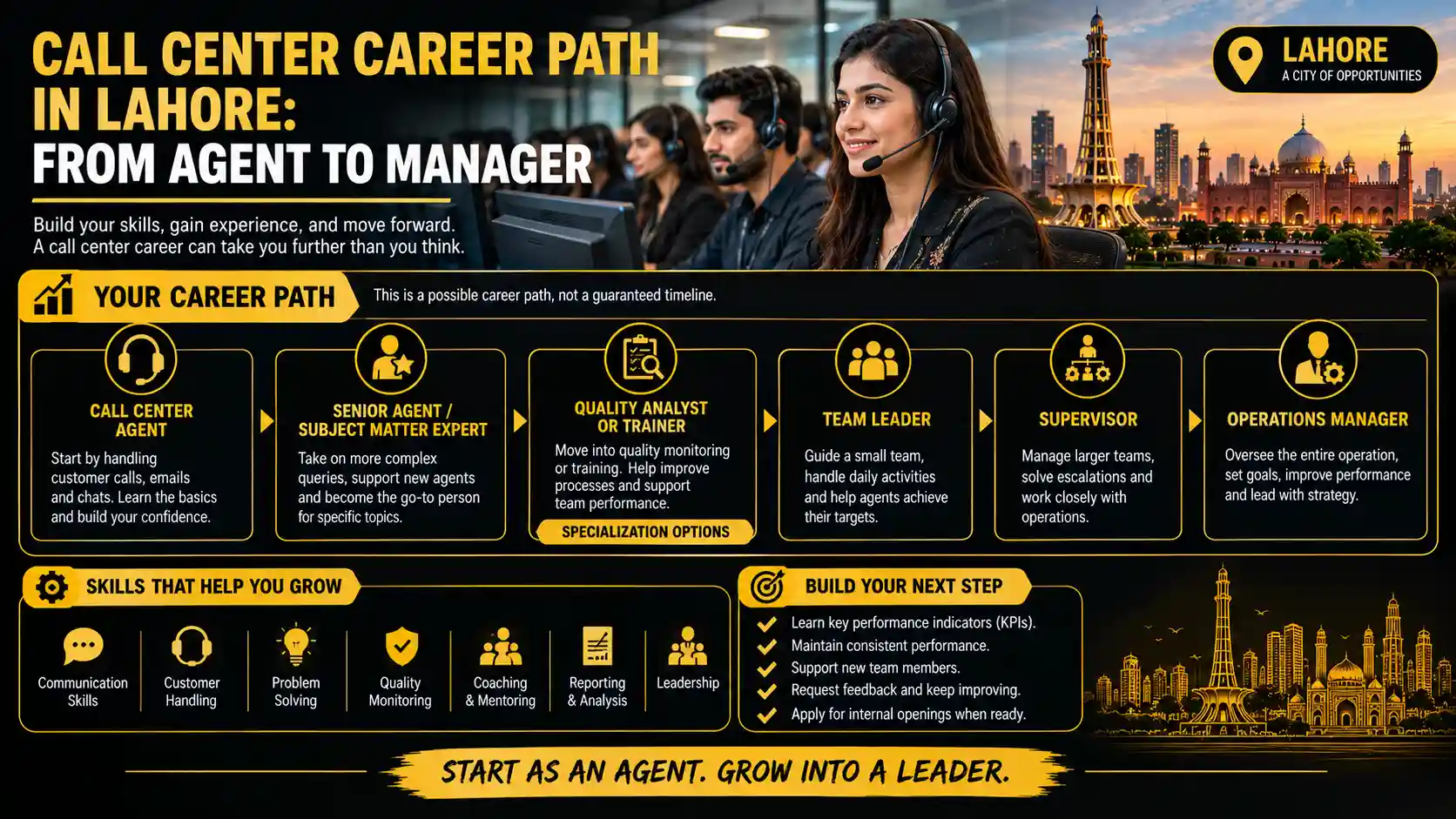
A call center job can be more than a way to earn a monthly salary. For people starting their careers in Lahore, it can provide a chance to develop communication skills, gain professional experience, and move into leadership roles over time.
Many people begin as call center agents without previous experience. They learn how to communicate with customers, use company systems, handle complaints, and meet performance targets. With consistent effort and the right skills, they may progress into senior agent, team leader, quality assurance, training, and management positions.
However, career growth does not happen automatically. Employees need to understand what each role involves, which skills employers value, and how to prepare for the next step.
If you are considering a long-term career in the call center industry, this guide explains the typical call center career path in Lahore, from your first job to a management position.
1. Call Center Agent: Where Most Careers Begin
The call center agent role is usually the starting point for people entering the industry. Agents communicate with customers, answer questions, provide information, resolve problems, or help generate sales, depending on the campaign.
In Lahore, job responsibilities can vary between local customer support campaigns and international campaigns serving customers in other countries.
New employees generally receive training on the company’s products, services, software, communication standards, and operating procedures.
During the first few months, your main goal should be to understand the job and build a strong foundation. Focus on speaking clearly, listening carefully, following instructions, and maintaining a professional attitude.
Employers may evaluate agents using performance measures such as attendance, call quality, customer satisfaction, sales results, and compliance with company procedures.
How to grow at this stage: Be consistent, accept feedback, learn from experienced colleagues, and ask questions when something is unclear. A reliable agent who improves steadily is better positioned for future opportunities.
2. Senior Call Center Agent: Building Experience
After gaining experience, some agents progress to senior agent positions. The exact requirements depend on the company, but this role often involves stronger performance, deeper product knowledge, and the ability to handle more complicated customer situations.
Senior agents may help new employees understand procedures, share solutions to common problems, and assist colleagues when a supervisor is unavailable.
This position requires more than completing calls successfully. You should be able to explain your decisions, identify recurring issues, and maintain consistent performance during busy periods.
For example, an experienced customer support agent may recognize that several customers are reporting the same problem. Instead of treating every call as an isolated issue, the agent can document the pattern and share it with the appropriate team.
How to move forward: Develop problem-solving skills, improve your product knowledge, and learn how the team measures performance. If you want to become a team leader, start helping colleagues in a professional and supportive way.
3. Team Leader: Managing a Group of Agents
Becoming a team leader is a major step because the focus shifts from individual performance to the performance of an entire team.
A team leader typically monitors results, supports agents, provides feedback, helps resolve difficult cases, and works with management to meet department targets.
In sales campaigns, team leaders may track conversions, sales targets, and agent productivity. In customer support campaigns, they may focus on service quality, response times, customer satisfaction, and issue resolution.
Strong communication is essential because team leaders need to explain expectations clearly and address performance problems without creating unnecessary pressure.
They also need to understand reports and recognize when an employee needs additional training.
How to prepare for this role: Practise giving constructive feedback, learn basic reporting, improve your time management, and understand how to motivate different people. Being a strong agent helps, but leadership requires a different set of skills.
4. Quality Assurance Analyst: A Different Career Option
Not every experienced agent wants to manage a team. Quality assurance (QA) offers another possible career path.
QA analysts review customer interactions to check whether agents follow company procedures, communicate accurately, and meet established quality standards.
Their responsibilities may include reviewing calls, completing evaluation forms, identifying repeated mistakes, preparing reports, and sharing feedback with agents and team leaders.
This role suits people who pay attention to detail and can evaluate conversations fairly. They need to identify genuine problems rather than simply looking for mistakes.
For example, a QA analyst may notice that agents frequently fail to explain an important policy. The analyst can report the pattern and recommend additional training.
To pursue QA, build a strong understanding of company policies, communication standards, documentation, and performance evaluation. Experience handling calls can help you understand the challenges agents face.
5. Call Center Trainer: Helping New Employees Succeed
Training is another career option for experienced call center professionals.
Trainers help new employees understand products, systems, customer handling procedures, and workplace expectations. Depending on the company, they may also conduct refresher sessions for existing agents.
A good trainer must explain information in simple terms. Knowing the job well is not enough; you also need to help other people understand it.
Patience, presentation skills, organization, and the ability to identify learning gaps are important in this position.
If you are interested in training, practise explaining common procedures to colleagues, prepare simple learning materials, and learn how to give useful feedback.
This role can be a good fit for people who enjoy teaching and helping others improve.
6. Supervisor: Overseeing Daily Operations
Supervisors usually have broader responsibilities than team leaders. Depending on the company’s structure, they may oversee several teams, coordinate with other departments, manage escalated customer issues, and report operational results to senior management.
They must understand staffing needs, performance trends, service quality, and daily targets.
A supervisor may also help implement new procedures, address recurring operational problems, and ensure that teams follow company policies.
This position requires sound judgment because decisions can affect employees, customers, and business results.
To prepare for a supervisory role, develop your leadership skills, learn to interpret performance reports, and become comfortable handling difficult situations. Understanding how different departments work together can also help.
7. Operations Manager: Leading the Call Center
The operations manager is responsible for the broader performance of a call center or a major part of its operations.
Responsibilities may include managing team leaders and supervisors, reviewing business targets, planning staffing requirements, monitoring service quality, and improving operational efficiency.
In some companies, operations managers also work with clients, prepare performance reports, manage budgets, and help develop business strategies.
The role requires a wider view of the business. Instead of focusing only on individual calls, managers must understand how staffing, training, technology, employee performance, and customer experience affect overall results.
Experience in leadership roles can provide a foundation for this position. Knowledge of reporting, workforce planning, problem-solving, and performance management is also valuable.
How to prepare: Learn how to interpret operational data, manage competing priorities, communicate with senior management, and make decisions based on evidence rather than assumptions.
8. Skills That Help You Progress Faster
Although job titles and promotion requirements differ between employers, certain skills can support career growth at almost every stage.
Communication Skills
Clear communication helps agents serve customers and helps leaders explain expectations, resolve disagreements, and support employees.
Problem-Solving
Managers and team leaders need to understand the cause of a problem before deciding how to fix it. Avoid relying on temporary solutions when the same issue keeps returning.
Computer and Reporting Skills
Call centers often use customer relationship management systems, spreadsheets, dashboards, and reporting tools. Learning to work with these systems can help you take on more responsibility.
Leadership and Teamwork
Leadership involves listening, setting clear expectations, helping colleagues improve, and taking responsibility for decisions. You can begin developing these skills before receiving a formal promotion.
Adaptability
Campaign requirements, customer expectations, and technology can change. Employees who are willing to learn new systems and adjust to updated procedures can handle these changes more effectively.
9. How Long Does It Take to Become a Manager?
There is no fixed timeline for moving from agent to manager. Progress depends on your performance, experience, available vacancies, company structure, and ability to handle greater responsibility.
Some employees may progress relatively quickly in companies with clear promotion systems. Others may need several years to gain the experience required for leadership roles.
Promotions are not guaranteed simply because you have worked at a company for a certain period.
Instead of focusing only on time, ask your manager which skills and performance standards are required for the next position. Keep track of your achievements and request feedback on areas where you need improvement.
10. Salary Growth and Career Opportunities in Lahore
Call center salaries in Lahore vary according to the campaign, employer, experience, working hours, and level of responsibility.
Entry-level agents generally have different earning opportunities from senior agents, team leaders, QA analysts, trainers, supervisors, and operations managers. Sales campaigns may also offer commissions or performance incentives, depending on company policy.
However, a higher job title does not always guarantee a better overall package. Compare basic salary, incentives, working hours, benefits, responsibilities, and promotion opportunities when considering a new position.
If you are planning a long-term career, look for employers that provide structured training, clear performance expectations, and opportunities to develop new skills.
Common Mistakes That Can Slow Career Growth
Some employees work hard but overlook the habits needed for promotion.
Common mistakes include ignoring feedback, arriving late, repeating the same errors, communicating poorly with colleagues, and focusing only on personal targets.
Another mistake is assuming that excellent individual performance automatically makes someone a good leader. Managing people requires patience, fairness, organization, and the ability to help others succeed.
You can avoid these problems by setting clear goals, asking for feedback, improving one skill at a time, and taking responsibility for your work.
Final Thoughts
The call center career path in Lahore can offer several opportunities, from entry-level agent positions to team leadership and operations management. Employees can also build careers in quality assurance, training, and other specialized roles.
The best approach is to treat your first job as an opportunity to learn. Build strong communication skills, understand performance expectations, and become someone your team can rely on.
When you are ready for the next step, ask what the role requires and start developing those skills before a vacancy becomes available. With consistent effort, practical experience, and a willingness to improve, you can build a career that goes beyond answering calls.
FAQs
Can I become a manager after starting as a call center agent?
Yes. Some professionals progress from agent to senior agent, team leader, supervisor, and operations manager. The path depends on performance, experience, available opportunities, and the company’s promotion structure.
Do I need a degree to become a call center manager in Lahore?
Requirements vary by employer. Some companies prefer candidates with a bachelor’s degree, while others place greater emphasis on relevant experience, leadership ability, and operational knowledge.
Which skills are most important for call center promotion?
Communication, problem-solving, teamwork, leadership, reporting, time management, and the ability to coach others are all useful for career progression.
Is quality assurance a good career option in a call center?
QA can be a suitable option for people who pay attention to detail, understand company procedures, and can evaluate customer interactions fairly. It also offers a path beyond direct call handling.
How can fresh graduates grow in the call center industry?
Fresh graduates should focus on learning company procedures, improving communication, meeting performance expectations, accepting feedback, and developing computer and problem-solving skills.
Can call center experience help me get other jobs?
Yes. Skills gained in call center work, including customer service, sales, communication, teamwork, and problem-solving, can be useful in other business and service-related roles.