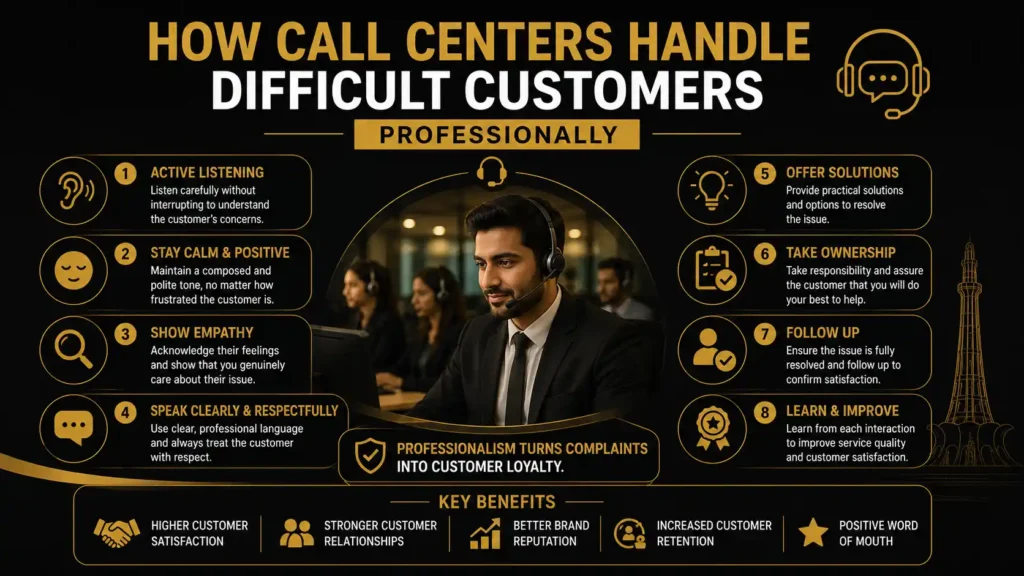
One of the most difficult aspects of the call center is dealing with difficult customers. Regardless of the quality of the services they offer, there are times when customers become frustrated, angry, confused, or disappointed with the services of a company.
Occasionally, they are angry due to late service. At times, it’s a matter of billing, technical issues, or expectations not met. In most cases, the Customer is not at fault; the Customer is at fault.
Here is where having a professional becomes important.
An agent at a call center understands and knows how to tackle challenging conversations without making them worse. It’s not about winning an argument. The bottom line: to find out what the issue is so as to defuse any tension and work towards a solution.
Let’s take a look at how professional call centers deal with challenging customers.
The first criterion is easy – keep your cool.
If a customer yells at you or is aggressive, you can easily respond out of emotion, and things can escalate quickly. Professional agents know how to regulate themselves, their tone, their emotions, and how they react.
This does NOT involve denying the customer his/her frustration. It means to keep it at a level and to deal with the conversation correctly.
Calm agents:
A calm reaction frequently brings about the character of the customer. If the agent is professional, the customers will normally also relax.
This is where emotional control is a key element in customer support.t.
Many difficult situations become worse because the customer feels ignored.
People want to feel heard.
Before offering solutions, professional agents listen carefully and let customers explain the issue fully. Interrupting too early can make frustrated customers even angrier.
Active listening helps agents understand both the problem and the emotion behind it.
Good listening includes:
Sometimes customers calm down simply because someone listened properly.
That alone can change the direction of the call.
Empathy is a powerful tool in customer service.
When customers are upset, they want acknowledgment. They want to know the company understands their frustration.
Simple phrases can help:
These responses do not instantly solve the issue, but they reduce emotional tension.
Empathy does not mean automatically agreeing with everything the customer says. It means recognizing their feelings while staying professional.
Customers usually respond better when they feel respected.
Arguing with customers almost never ends well.
Even if the customer is wrong, correcting them aggressively creates resistance. Professional agents avoid debates and focus on resolving the issue.
For example, instead of saying:
“You are wrong.”
A better response is:
“Let me clarify what happened.”
This small difference matters.
Professional call centers train agents to use solution-focused language instead of confrontational language.
That means:
The conversation should always move toward resolution, not conflict.
Sometimes the issue customers mention is not the real issue.
A customer may complain about poor service, but the actual problem could be delayed communication. Another customer may sound angry about a charge, but the real concern is confusion about billing.
Professional agents ask smart questions to find the root cause.
Examples include:
These questions help uncover important details.
Once the root problem is clear, finding the right solution becomes easier.
Difficult customers often become more frustrated when explanations are unclear.
That is why communication must stay simple and direct.
Professional agents avoid complicated terms and confusing explanations. They explain the situation in plain language.
Clear communication includes:
For example, after explaining a solution, agents may ask:
“Does that make sense?”
This ensures both sides stay aligned.
Miscommunication creates frustration. Clarity reduces it.
Listening and empathy matter, but customers also want solutions.
Once the problem is understood, the next step is action.
Professional call centers train agents to offer realistic and practical next steps. Customers feel more confident when they know exactly what will happen next.
Good solutions include:
The key is transparency.
If something cannot be fixed right away, agents should say so honestly while explaining the next process.
False promises damage trust.
Clear expectations build trust.
Not every issue can be solved by a frontline agent.
Some situations require supervisors or specialized departments.
Professional call centers define escalation procedures for cases involving:
A strong agent knows when escalation is necessary.
Escalating at the right time prevents unnecessary frustration.
However, escalation should not become an excuse to avoid responsibility. Agents should first do everything within their authority.
Customers appreciate effort.
Unfortunately, some customers cross the line.
They may use insults, threats, or abusive language.
Professional call centers protect employees by creating clear policies for abusive behavior.
Agents are trained to set boundaries respectfully.
Examples include:
If abuse continues, the call may be escalated or ended according to company policy.
Professional service does not mean tolerating harassment.
Employee wellbeing matters too.
Healthy work environments protect both customers and staff.
Handling difficult customers is a skill that improves with training.
Good call centers invest heavily in agent development.
Training often includes:
Prepared agents perform better under pressure.
Confidence also improves with experience.
The more situations agents handle, the better they become at reading customer emotions and responding effectively.
This experience becomes one of their strongest professional assets.
Modern call centers also use technology to improve difficult interactions.
CRM systems help agents see customer history, previous complaints, and past conversations. This gives valuable context during calls.
Useful tools include:
These tools help agents respond faster and more accurately.
When agents have the right information, they can solve issues more efficiently.
Better tools often lead to better customer experiences.
Handling difficult customers professionally is not about having perfect conversations every time. It is about staying calm, listening carefully, and guiding the interaction toward a solution.
Professional call centers train agents to manage pressure, communicate clearly, and handle conflict with maturity. They understand that frustrated customers need both empathy and solutions.
Difficult conversations are part of customer service, but they do not have to become negative experiences.
With the right skills, training, and mindset, even challenging interactions can end positively.
In the end, professionalism is what turns a difficult call into a successful resolution.