A call center is a business that is allegedly considered a stepping stone for fresh graduates, students, or anyone seeking a fast job. Many think that it is just a temporary job with no potential. However, that notion is antiquated.
With this perspective, the call center industry has actually become among the most satisfying and lucrative careers for those individuals willing to steer clear of sloppy working methods and also display a will to learn, work hard, and grow as professionals. An entry-level customer support position can eventually become a leadership, operations, training, or management position.
The best thing is that the growth in the industry can be performance-driven. Typically, your skills, experience, and performance are important, and your background is not.
If you are thinking of pursuing a career in this field, it is advantageous to learn where the opportunities exist and the route you will generally take to get them.
The majority of people have been directed to this industry as call center or customer support personnel.
It is here that you get the fundamentals of the business. You are in direct contact with the customer and handle customer concerns, inquiries, and in some cases sales and Technical Support.
During this time, you learn important professional skills like:
Such abilities may appear easy at the outset, but if an individual wants to be successful in the future, these are key to their success.
You will also learn to remain calm under pressure while working on calls. You learn how to manage challenging conversations and stay professional.
This is a good experience to have with all jobs.
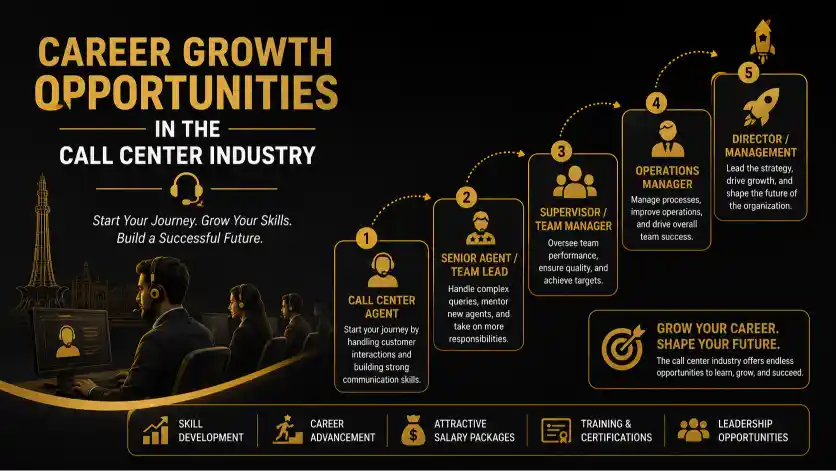
But with experience and strong performance, a lot of agents progress to more senior roles.
Senior agents generally have more involved functions than standard agents. They can handle tricky customer scenarios, help out new hires, or help the team leaders during peak times.
This promotion may include:
Senior agents often are expected to perform at a high level, whilst contributing to maintaining the quality of the team.
This is an important step because it indicates if you have readi
The most common career progression in call centers is as a team leader.
A team leader is in charge of a group of agents and assists them in attaining their day-to-day objectives. Instead of dealing with customers, you begin to deal with people.
You might be expected to:
This position involves sound communication and leadership abilities.
Many people don’t do well at this one since managing people is a lot different from managing calls. Requires patience, emotional intelligence, and leadership skills.
Helping to become a team chief is the initial significant step to management for a lot of professionals.
Not all people are interested in leadership. Others would rather work at an analytical job.
This is where Quality Assurance, often referred to as QA, is a wonderful career option.
Quality assurance personnel monitor taped phone sessions, conversations, or e-mail and audit service quality. Their role is to make sure that agents are adhering to the company guidelines and providing a positive customer experience.
They’re thoughtful about things such as:
Individuals interested in this occupation tend to be interested in work that involves checking, inspecting, evaluating, or experimenting, and work activities that involve evaluating written materials and formulating judgments regarding them.
Quality analysts have a significant role in enhancing the overall service performancee.
Many of the experienced call center professionals will be making the transition to the training departments.
Trainers train new hires for systems, processes, scripts, and company expectations. They also hold ‘refreshers’ for current employees.
A trainer needs to possess a profound understanding of the business, along with the ability to train others.
Strong trainers can:
Trainers are important individuals who enjoy sharing their knowledge and experience with others, and so it can be a fulfilling career.
Many companies are interested in inside trainers, as they know what is really hard in the field.
Your work experience might lead to a position as a supervisor or operations manager.
The positions come with larger responsibilities.
Supervisors may need to supervise more than one team with a general focus on productivity, staffing, service levels, and business performance.
Common responsibilities include:
Operations Manager are closely connected to the top management to guarantee the efficiency of the call center.
Business thinking is very important at this level! No, you’re not just thinking about calls; you’re now thinking about scale, performance, cost, and customer satisfaction.
These positions may be associated with high pay and job security.
The call center industry is certainly larger than the voice industry.
Numerous companies have been able to develop in a variety of specialized sectors, like:
This will provide professionals with a few career paths.
For instance, an individual who excels at analysis can work in reporting and analytics. Someone who is good with people could be moving in the direction of recruitment or HR.
Industry now provides opportunities for various abilities.
It’s part of the reason why many professionals stick around for years.
The greatest benefit of a call center job is learning the skills.
You can be out of this field in the future, but the skills are still important.
You develop:
Industries such as banking, sales, healthcare, retail, logistics, and corporate management can benefit from these skills.
This means one can have options other than to end up in the BPO industry ever since the ventures extended into the call center.
After reviewing the list of many successful business managers who began their careers in other industries, you should make a well-informed choice about your trade.in customer support roles.
One of the biggest reasons individuals prefer this business is merit.
For many traditional jobs, credentials or years of experience can play a major role in whether a worker is promoted or not. Call centers are sometimes a place where performance is more important.
Growth can be more rapid than anticipated if one consistently produces, is shown to have leadership qualities, and remains professional.
Businesses take initiatives from people who:
This definitely provides a real chance for ambitious professionals..
Careers can’t just float upwards.
There’s got to be further learning.
Customer service has risen to a new level of change thanks to technology. The industry is changing with AI tools, automation, chat support, and advanced CRM systems.
Experts who are able to adjust will remain ahead.
You can improve by:
When humans don’t learn, they are likely not to develop.
The call center industry offers much more than entry-level jobs. For the right folks, it can turn into a long-term career that can doubtlessly be constructed upon with thrilling progress possibilities.
You can begin on one of the levels of progression as an agent, progressing to leadership, quality assurance, analytics, and/or operations management. The route will be unique to each person’s strengths, aims, and desire to learn.
The secret to success in this field is that it’s not where you start. It’s about how continually you learn, perform, and grow.
If one is looking for professional growth, a career in the call center world could present steady earnings, transferable abilities, and career advancement.